
Chemistry calculator
Titration Calculator
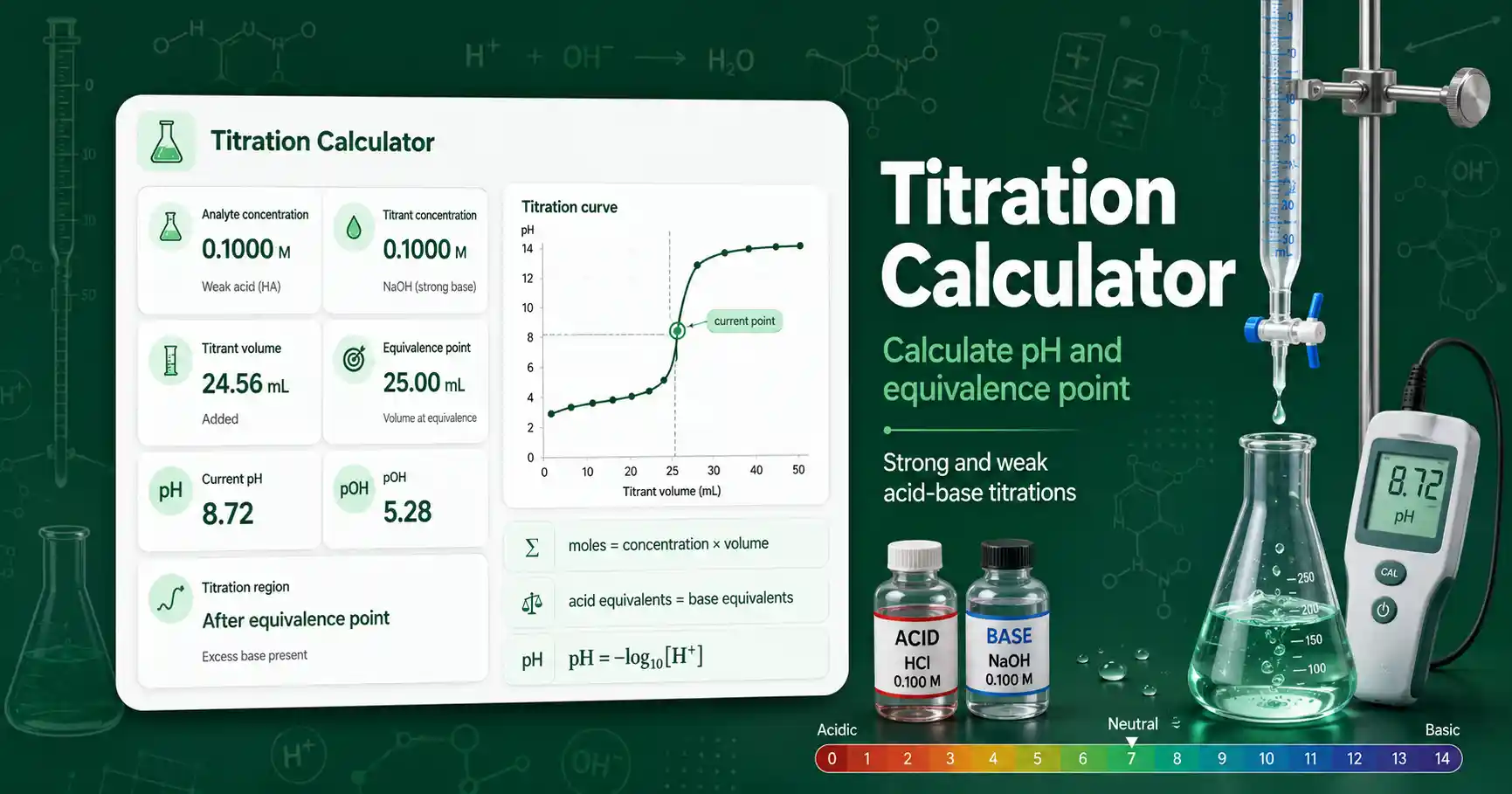
Use this Titration Calculator to estimate pH, pOH, equivalence volume, and the current acid-base region from analyte and titrant data. It supports strong acid-base titrations and advanced weak acid or weak base cases for classroom and lab math practice.
Acid-base titration dashboard
Calculate pH at any titration point
Enter analyte and titrant details to estimate the equivalence volume, current pH, pOH, and titration region.
Inputs
Strong acid/baseResults
25 °C modelBefore equivalence point
Interpretation
The acid is still in excess, so the pH is controlled by the remaining hydrogen ion concentration.
Strong acid and strong base are treated as fully dissociated monoprotic species at 25 °C.
Titration checkpoints
Quick curve preview| Point | Titrant volume | Estimated pH | Region |
|---|---|---|---|
| Start | 0 mL | 1.00 | Initial acidic solution |
| Half-equivalence | 12.5 mL | 1.477 | Before equivalence point |
| Equivalence | 25 mL | 7.00 | Equivalence point |
| Current point | 12.5 mL | 1.477 | Before equivalence point |
Titration Calculator for acid-base pH points
A titration calculation compares the amount of analyte in the flask with the amount of titrant added from the burette. The key event is the equivalence point, where acid equivalents and base equivalents are equal. This calculator uses concentration and volume to find those equivalents. It then estimates the pH at the titrant volume you enter.
Students can use the tool to check homework steps for strong acid and strong base titrations. Teachers can use it to create examples that show the start point, half-equivalence point, equivalence point, and after-equivalence region. Lab workers can use it as a quick educational check before reviewing a formal titration worksheet. Researchers can use it to sanity-check simple monoprotic acid-base calculations when building teaching notes or assay support material.
The calculator is not a replacement for an experimentally measured titration curve. Real titrations depend on temperature, activity effects, electrode calibration, ionic strength, and sample composition. Verify critical lab calculations independently before using them in real experiments.
Titration Calculator formula and assumptions
The equivalence volume comes from the relationship moles of analyte equals moles of titrant at stoichiometric balance. For a monoprotic acid and monoprotic base, the mole ratio is one to one. The basic equivalence formula is Vtitrant = Canalyte × Vanalyte / Ctitrant. The calculator converts mL, L, and µL into liters before it calculates moles. It also converts M, mM, and µM into mol/L before using the values.
For a strong acid titrated with a strong base, pH before equivalence comes from the remaining H+ concentration. After equivalence, pH comes from the excess OH− concentration. At the strong acid-strong base equivalence point, the ideal pH is 7.00 at 25 °C. The same logic works in reverse for a strong base titrated with a strong acid. For a deeper review of titration concepts, see this OpenStax explanation of acid-base titrations.
Weak acid and weak base titrations need extra chemistry. A weak acid titrated with strong base forms a buffer before equivalence. In that region, the calculator uses the Henderson-Hasselbalch relationship with pKa and the acid-to-conjugate-base ratio. If you need to study the buffer equation separately, the Henderson-Hasselbalch Calculator is the better next step. At the weak acid equivalence point, the conjugate base hydrolysis raises pH above neutral. For a weak base titrated with strong acid, the conjugate acid at equivalence lowers pH below neutral.
Titration Calculator result interpretation
The pH result tells you the estimated acidity or basicity at the chosen titrant volume. The pOH result helps when excess hydroxide controls the solution after a base addition. The equivalence volume tells you how much titrant is needed to neutralize the analyte under the selected stoichiometry. The region label tells you whether the selected point is before equivalence, at equivalence, or after equivalence. A before-equivalence point means some original analyte remains. An after-equivalence point means the titrant is present in excess.
Rounding matters because small concentration differences near the equivalence point can cause large pH changes. A pH value near the steep part of a titration curve should not be overinterpreted. If your titrant volume is extremely close to the equivalence volume, use more significant figures in the concentration and volume inputs. If your sample is polyprotic, mixed, buffered, or poorly described by a simple acid-base model, this calculator may not match the real curve. For plain strong acid or strong base checks, the Acid-Base Calculator gives a simpler equivalent-based view.
Titration Calculator worked example
Given values: 25.0 mL of 0.100 M HCl is titrated with 0.100 M NaOH. The titrant volume added is 12.5 mL.
Formula: moles = concentration × volume, and pH = −log10[H+] before equivalence.
Substitution: acid moles = 0.100 × 0.0250 = 0.00250 mol. Base moles = 0.100 × 0.0125 = 0.00125 mol.
Remaining H+: 0.00250 − 0.00125 = 0.00125 mol in 0.0375 L, so [H+] = 0.0333 M.
Result: pH = −log10(0.0333) = 1.477. The equivalence volume is 25.0 mL.
Interpretation: The titration is before equivalence, so acid remains in excess and the solution is still strongly acidic.
Common titration calculation mistakes
A common mistake is using mL directly as liters inside the mole calculation. Another mistake is forgetting that pH switches from acid excess to base excess after equivalence. Weak acid titrations are often misread as neutral at equivalence, but their conjugate base can make the solution basic. Weak base titrations are often acidic at equivalence because the conjugate acid remains in solution. The pH at half-equivalence has special meaning in weak acid titration because pH equals pKa. The pOH at half-equivalence has special meaning in weak base titration because pOH equals pKb.
Student Questions About Titration Calculator
What does the Titration Calculator find?
It estimates the equivalence volume, pH, pOH, neutralization region, and excess acid or base at a selected titrant volume.
Can I use this calculator for weak acid titrations?
Yes. Use Advanced mode for a weak monoprotic acid titrated with strong base or a weak monoprotic base titrated with strong acid.
Why is the strong acid and strong base equivalence pH 7?
At 25 °C, equal equivalents of a strong acid and strong base leave water and a neutral salt, so the ideal equivalence pH is 7.00.
Why can a weak acid equivalence point be above pH 7?
The conjugate base formed at equivalence reacts with water and produces hydroxide, so the solution can be basic.