
Chemistry and biochemistry thermodynamics
Equilibrium Constant Calculator
Calculate an equilibrium constant from standard Gibbs free energy, convert K back into ΔG°, or compare Q with K to estimate reaction direction at a selected temperature.
Calculate K, ΔG°, or reaction direction
Use standard Gibbs free energy, equilibrium constant, or reaction quotient values. Temperature is included because K and ΔG depend on thermal energy.
Products are favored at equilibrium, but the mixture may still contain reactants.
Equilibrium Constant Calculator for ΔG° and K
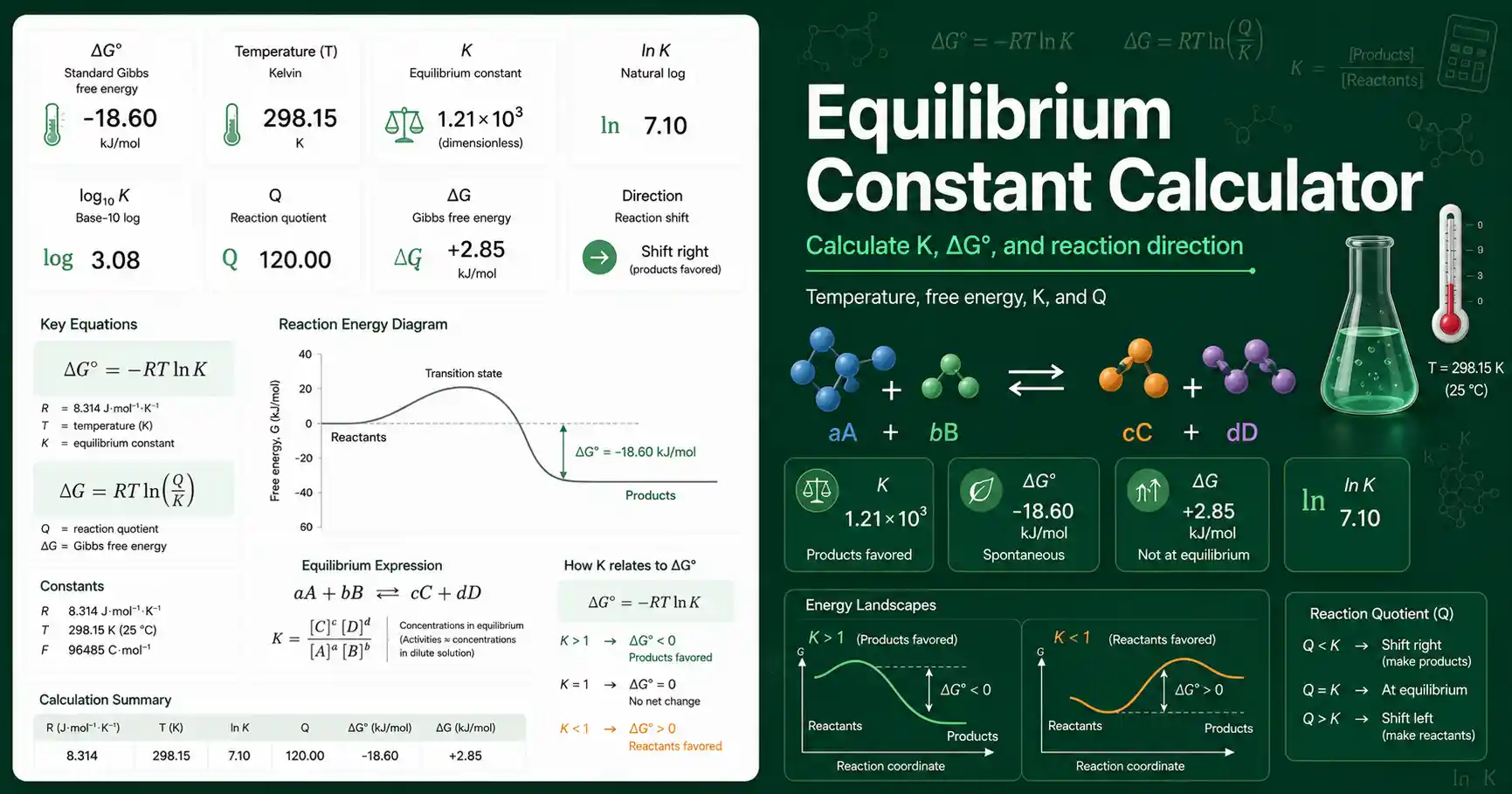
The Equilibrium Constant Calculator converts between a thermodynamic free-energy value and the equilibrium constant for a reaction. It uses the relationship between standard Gibbs free energy and the natural logarithm of K. A negative ΔG° gives K greater than 1, which means products are favored at equilibrium. A positive ΔG° gives K less than 1, which means reactants are favored at equilibrium. A ΔG° close to zero gives K close to 1, which means neither side strongly dominates under the selected standard state.
Students can use this calculator to check thermodynamics homework. Teachers can use it to show how small changes in ΔG° become large changes in K. Lab workers can use it to make quick equilibrium estimates during assay planning. Researchers can use it to compare binding, reaction, or biochemical equilibrium values in a common energetic scale. The calculator is educational and non-clinical. It does not replace validation with experimental data.
Equilibrium Constant Calculator formulas
The core equation is ΔG° = −RT ln K. In this equation, R is the gas constant, T is absolute temperature in kelvin, and K is the dimensionless equilibrium constant. The calculator uses R = 8.314462618 J mol⁻¹ K⁻¹. The tool converts Celsius to kelvin before performing the calculation. It also converts J/mol, kJ/mol, and kcal/mol into the same internal energy unit before solving.
The reaction-direction mode uses ΔG = RT ln(Q/K). In this equation, Q is the reaction quotient for the current mixture. If Q is smaller than K, the forward direction is favored because the mixture has not yet reached the product ratio expected at equilibrium. If Q is larger than K, the reverse direction is favored. If Q equals K, the reaction is at equilibrium and ΔG is zero. For a broader thermodynamic workflow, use the Gibbs Free Energy Calculator after this calculation.
How to interpret equilibrium constant results
K describes the composition of a reaction mixture at equilibrium. It does not describe how fast the reaction reaches equilibrium. A reaction with K = 1,000 strongly favors products, but it may still be slow if the activation barrier is high. A reaction with K = 0.001 strongly favors reactants, but it can still proceed measurably under driven or coupled conditions. This difference between thermodynamics and kinetics is important in chemistry, enzymology, and molecular biology.
A K value is often written without units because it is formally based on activities. Many classroom problems use concentrations as an approximation. This approximation is common for dilute solutions, but it can fail in concentrated, non-ideal, or high-ionic-strength mixtures. Temperature also matters because RT changes with temperature. A value calculated at 25 °C should not be treated as automatically valid at 37 °C, 4 °C, or a heated reaction condition.
Equilibrium constants also connect to acid-base calculations. Ka is an equilibrium constant for acid dissociation, and pKa is its negative logarithmic form. If your work involves acid dissociation rather than general reaction equilibrium, the Ka pKa Converter is usually the more direct tool.
Equilibrium Constant Calculator worked example
Given values: ΔG° = −5.70 kJ/mol and temperature = 25 °C.
Formula: ΔG° = −RT ln K, so K = e−ΔG°/RT.
Substitution: T = 298.15 K and ΔG° = −5700 J/mol, so K = e5700 / (8.314 × 298.15).
Result: K is about 9.96, which rounds to about 10.
Interpretation: Products are favored at equilibrium by roughly a ten-to-one ratio under the selected standard-state assumptions.
Common mistakes when calculating K from ΔG°
The most common error is mixing kJ and J in the same equation. ΔG° must use the same energy scale as R. The calculator avoids this by converting all selected energy units into joules per mole internally. Another common error is using Celsius directly in the thermodynamic equation. Thermodynamic temperature must be in kelvin. The calculator accepts Celsius for convenience, but it always solves with kelvin.
A third mistake is treating K as a concentration with units. The thermodynamic form of K is dimensionless because it is built from activities. Concentration-based classroom expressions are approximations. A fourth mistake is assuming that product-favored means complete conversion. Even a large K can leave measurable reactant. A fifth mistake is using Q and K from different reaction directions. Reverse reactions invert K, so the written chemical equation matters.
When to use this equilibrium calculation
Use this calculator when a problem gives ΔG° and asks whether reactants or products are favored. Use it when a paper reports K and you want the equivalent ΔG° value. Use it when you need to compare two reactions at the same temperature. Use it when you want to see how far a current reaction quotient is from equilibrium. Use it when writing a lab report that needs a clear thermodynamic interpretation.
The calculator is most reliable when the input values come from a well-defined reaction, a clear standard state, and a specified temperature. It is less reliable when activities differ strongly from concentrations. It is also limited when coupled reactions, precipitation, gas pressure, or phase changes change the effective reaction expression. For a careful conceptual explanation of equilibrium constants, Chemistry LibreTexts provides a useful overview of equilibrium constants.
User Queries About Equilibrium Constant Calculator
What does the Equilibrium Constant Calculator calculate?
It calculates K from ΔG°, calculates ΔG° from K, and compares Q with K to estimate reaction direction at a selected temperature.
Why must K and Q be positive?
K and Q appear inside natural logarithms. Zero and negative values are not valid in these equations.
Does a large K mean the reaction is fast?
No. A large K means products are favored at equilibrium. Reaction speed depends on kinetics, activation energy, catalysts, and mechanism.