
Thermodynamics calculator
Gibbs Free Energy Calculator
Calculate Gibbs free energy from enthalpy, entropy, temperature, equilibrium constant, or reaction quotient for chemistry and biochemistry problems.
Interactive thermodynamics tool
Calculate Gibbs free energy
Solve ΔG from enthalpy and entropy, calculate ΔG° from an equilibrium constant, or convert ΔG° back to K at a selected temperature.
Inputs
Results
Thermodynamically favorable under the selected conditions. This result uses ΔG = ΔH − TΔS at 298.15 K.
- The crossover temperature from ΔH/ΔS is about 625 K if ΔH and ΔS stay constant.
Verify critical lab calculations independently before using them in real experiments.
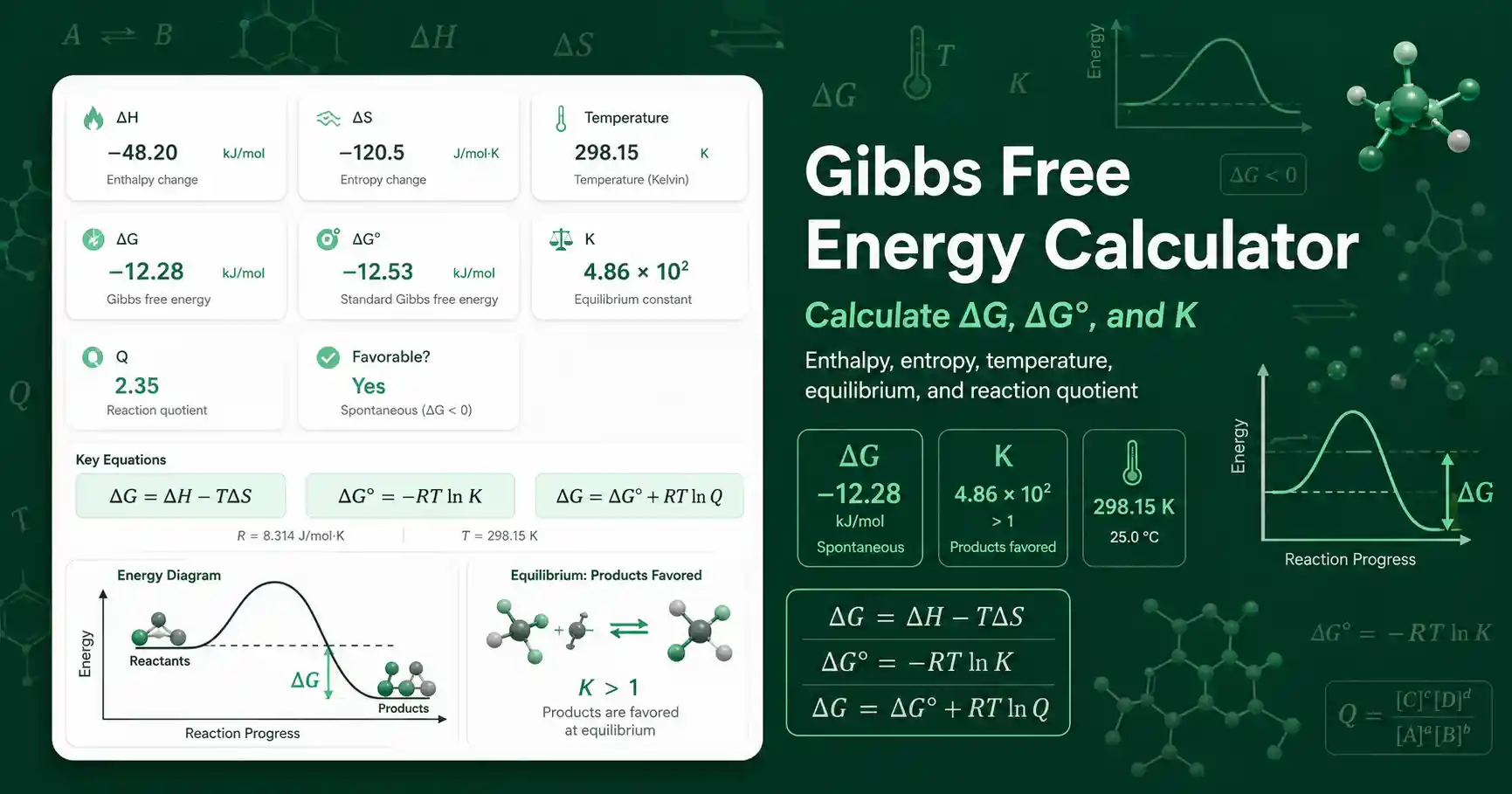
Gibbs Free Energy Calculator for ΔG and K
The Gibbs Free Energy Calculator helps you calculate whether a chemical or biochemical process is thermodynamically favorable under selected conditions.
It can calculate ΔG from enthalpy change, entropy change, and temperature.
It can calculate standard free energy change from an equilibrium constant.
It can also convert a standard free energy value back into an equilibrium constant.
Students can use the tool for general chemistry, physical chemistry, biochemistry, and molecular biology thermodynamics assignments.
Teachers can use it to show why temperature changes the balance between enthalpy and entropy.
Lab workers can use it as a quick educational check when interpreting equilibrium constants, binding constants, or reaction direction.
Researchers can use it as a browser-based sanity check before moving to full thermodynamic modeling or curve fitting.
If you are comparing ΔG° with equilibrium behavior, the Equilibrium Constant Calculator is a useful next step.
Gibbs Free Energy Calculator formula
The temperature-based formula is ΔG = ΔH − TΔS.
In this formula, ΔH is enthalpy change, ΔS is entropy change, and T is absolute temperature in kelvin.
Enthalpy and entropy must use compatible energy units before the subtraction is performed.
This calculator converts kJ, kcal, J, and cal values internally so the final result stays consistent.
The equilibrium formula is ΔG° = −RT ln K.
R is the gas constant, T is absolute temperature, and K is a dimensionless equilibrium constant.
A large K gives a negative ΔG° because products are favored at equilibrium.
A small K gives a positive ΔG° because reactants are favored at equilibrium.
OpenStax gives a helpful educational overview of Gibbs free energy and chemical equilibrium: Free Energy.
Gibbs Free Energy Calculator result interpretation
A negative ΔG means the process is thermodynamically favorable under the selected conditions.
A positive ΔG means the process is thermodynamically unfavorable under the selected conditions.
A ΔG close to zero means the system is close to equilibrium.
A favorable ΔG does not automatically mean the reaction is fast.
Reaction speed depends on activation energy, catalysts, enzymes, diffusion, and experimental conditions.
In biochemistry, ATP hydrolysis often drives coupled reactions because the combined ΔG can become negative.
In binding studies, a stronger apparent association usually corresponds to a more negative binding free energy.
Use the Protein Binding Calculator when you want to connect Kd, fractional occupancy, and binding equilibrium more directly.
Gibbs Free Energy Calculator assumptions
The calculator assumes the supplied thermodynamic values describe the same reaction direction.
Reversing a reaction changes the sign of ΔG, ΔH, and ΔS.
The calculator assumes temperature is constant during the calculation.
The ΔH and ΔS method assumes those values remain reasonably constant over the selected temperature range.
The ΔG° and K relationship assumes standard-state thermodynamic conventions.
The reaction quotient Q lets you adjust standard free energy to a non-equilibrium mixture.
If Q is greater than K, the calculated ΔG tends to push the reaction toward reactants.
If Q is less than K, the calculated ΔG tends to push the reaction toward products.
Unit errors are common, so always check whether entropy is entered in J/mol/K or cal/mol/K.
Verify critical lab calculations independently before using them in real experiments.
Gibbs Free Energy Calculator worked example
Given values: ΔH = −75 kJ/mol, ΔS = −120 J/mol/K, and temperature = 298.15 K.
Formula: ΔG = ΔH − TΔS.
Unit conversion: ΔS = −120 J/mol/K = −0.120 kJ/mol/K.
Substitution: ΔG = −75 − 298.15 × (−0.120).
Result: ΔG = −39.22 kJ/mol.
Interpretation: the reaction is thermodynamically favorable at 298.15 K because ΔG is negative.
The same reaction may become less favorable at higher temperature because the entropy term is negative in this example.
Student Questions About Gibbs Free Energy
What does the Gibbs Free Energy Calculator calculate?
It calculates ΔG from ΔH, ΔS, and temperature, calculates ΔG° from K, adjusts ΔG with Q, and converts ΔG° back to K.
What does a negative ΔG mean?
A negative ΔG means the process is thermodynamically favorable under the selected conditions, but it does not prove that the reaction will happen quickly.
Why must temperature be in kelvin?
Thermodynamic equations use absolute temperature, so Celsius values must be converted to kelvin before using ΔG = ΔH − TΔS or ΔG° = −RT ln K.